
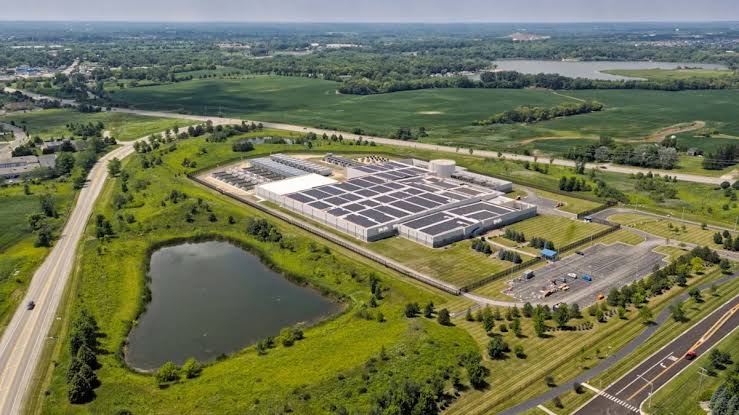
The artificial intelligence boom is creating a growing environmental problem that technology companies can no longer afford to ignore. A new MIT study estimates that electricity demand from US data centers was associated with approximately 650 premature deaths in 2023, exposing the public health consequences of an industry racing to build ever-larger computing infrastructure.
November 25, 2026
The global technology industry has spent billions of dollars building data centers to power artificial intelligence, cloud computing, and increasingly sophisticated digital services. But while companies promote AI as the next great technological revolution, the infrastructure behind it carries environmental costs that extend far beyond the buildings housing the servers.
A new study led by researchers at the Massachusetts Institute of Technology (MIT) has put a disturbing number on part of that cost.
Published in the scientific journal Environmental Research Letters on November 19, 2026, the research estimates that electricity demand from US data centers contributed to approximately 650 premature deaths in 2023 through increased air pollution.
The researchers attributed 513 estimated deaths to fine particulate matter known as PM2.5, while another 137 were associated with ground-level ozone pollution.
These are modeled estimates, not individually verified deaths. Nevertheless, the findings raise serious questions about the environmental consequences of the rapidly expanding data center industry.
The Pollution Does Not Stay Near Data Centers
One of the most troubling findings is that communities suffering the health consequences are not necessarily located near data center facilities.
Much of the electricity demand examined by researchers was concentrated in northern Virginia and Texas. However, some of the highest estimated mortality rates occurred in Midwestern states, including Iowa, Nevada, South Dakota, and Kansas.
Why?
Because electricity grids are interconnected.
When data centers consume more electricity, power generators across different regions must increase production to meet demand. Those generators frequently rely on fossil fuels, including coal and natural gas.
The resulting emissions contain nitrogen oxides and sulfur dioxide, which contribute to the formation of ozone and fine particulate pollution.
Atmospheric conditions then transport pollutants across state borders, exposing communities far removed from the original source of electricity consumption.
In other words, a technology company can build a data center in one state while communities hundreds of miles away bear part of its pollution burden.
Big Tech’s Clean Energy Promises Face a Difficult Reality
Technology companies have increasingly promoted renewable energy commitments, carbon-neutral operations, and sustainable data center development.
But the MIT findings highlight a critical gap between corporate sustainability messaging and the actual electricity systems supporting the digital economy.
A data center does not operate on corporate environmental pledges. It requires electricity around the clock.
When renewable generation is insufficient to meet additional demand, conventional power plants may have to increase output.
This creates a difficult challenge for technology companies investing heavily in AI infrastructure: expanding computing capacity without increasing the environmental burden of electricity generation.
The issue becomes particularly important as AI models become more computationally intensive and companies compete to build increasingly powerful data centers.
Rural Communities Could Pay a Higher Price
The study also identifies an important geographical inequality.
Rural populations face higher estimated mortality risks from data center-related electricity demand than urban populations.
This is particularly concerning because communities outside major technology hubs may have little influence over the infrastructure investment decisions driving additional electricity consumption.
The findings suggest that evaluating data center projects solely on land availability, electricity prices, and proximity to fiber-optic networks is insufficient.
Governments must also consider the environmental consequences of the power plants supplying those facilities.
The Next Data Center Controversy Could Be About Public Health
The AI industry is entering a period in which access to electricity is becoming as strategically important as access to advanced processors.
Amazon, Microsoft, Google, Meta, and other major technology companies are investing heavily in infrastructure to support AI development.
But the MIT research raises a question that regulators and investors cannot ignore: who should be responsible for the wider health consequences of the electricity consumed by these facilities?
The study does not establish that any particular company caused the estimated deaths. Nor does it provide a complete assessment of every environmental impact associated with data centers.
However, it demonstrates why the electricity supply chain must become part of the public debate surrounding AI infrastructure.
Future data center approvals should consider emissions from electricity generation, regional air quality, renewable energy availability, and the health risks faced by surrounding and downwind communities.
The researchers also intend to investigate the effects of on-site power generation and whether more flexible data center operations could reduce pollution.
AI Innovation Must Not Become an Environmental Liability
Artificial intelligence is transforming healthcare, manufacturing, finance, education, and scientific research. Its potential benefits are enormous.
But technological progress cannot be measured exclusively by processing speed, model performance, market capitalization, or the number of data centers companies build.
The infrastructure supporting AI must also be judged by its environmental and public health consequences.
The MIT study offers a warning that the technology industry should take seriously: the cost of the AI revolution is not limited to electricity bills and expensive GPUs.
It can also be measured in polluted air and human lives.
If Big Tech wants the world to embrace an AI-powered future, it must demonstrate that the infrastructure powering that future does not come at an unacceptable cost to public health.