
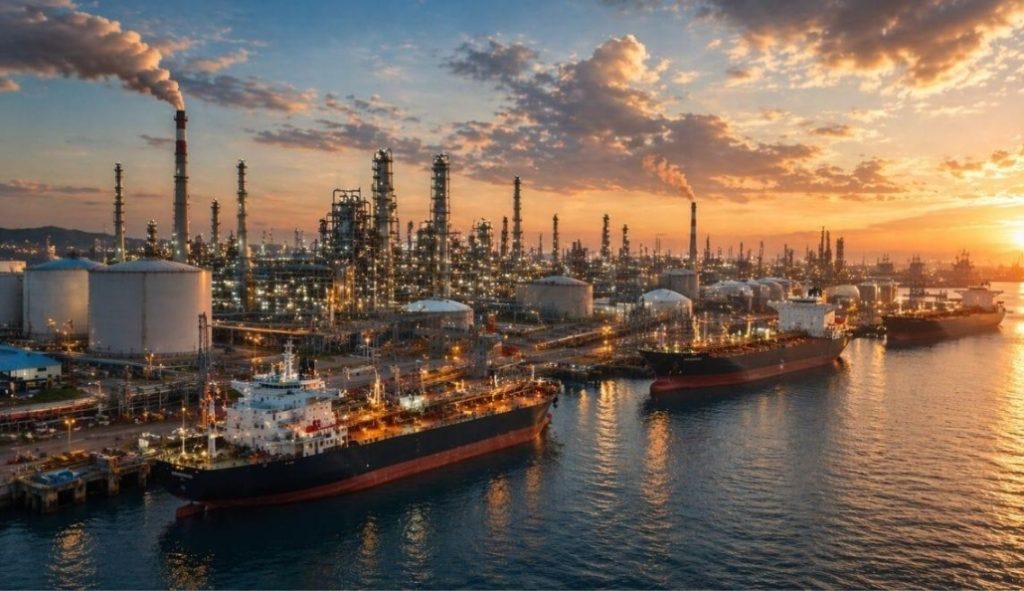
Oil markets are entering a critical period as geopolitical tensions in the Middle East collide with growing fears of a global supply surplus. With OPEC+ preparing to determine its 2027 production policy, disagreements among major oil producers could complicate efforts to stabilize prices and reshape the global energy market.
November 25, 2026 | Global Economy & Energy
The global oil market is facing an increasingly complicated outlook as producers prepare for another major battle over production levels.
Crude prices have experienced significant volatility this week, reflecting two competing forces: concerns about supply disruptions in the Middle East and expectations that global oil production could exceed demand in 2027.
On Wednesday, November 25, Brent crude traded around $90–$92 per barrel, while US West Texas Intermediate (WTI) traded around $80–$82.
The market reaction highlights how sensitive energy prices remain to geopolitical developments, shipping security, and decisions by major oil-producing countries.
But beneath the daily price movements, a deeper problem is emerging: the world’s largest oil producers are facing increasingly difficult decisions about how much crude to produce.
OPEC+ Faces a Difficult Production Decision
The upcoming November 29 OPEC+ meeting is attracting significant attention from energy traders and governments.
The alliance must determine its production strategy for 2027 while managing disagreements over national production capacity and market share.
Iraq and Kazakhstan are seeking higher estimates of their sustainable oil production capacity as part of the group’s first independent capacity review.
These estimates matter because they could influence future production targets.
Iraq has reportedly challenged preliminary estimates that placed its sustainable production capacity at approximately 4.9 million barrels per day.
Baghdad argues that years of investment should justify a higher allocation.
The disagreement is politically sensitive because production quotas determine how much individual members can legally produce under the group’s coordinated policy.
The dispute also highlights a fundamental problem within OPEC+: members have different economic priorities and varying levels of dependence on oil revenues.
The UAE’s Departure Adds Another Complication
The United Arab Emirates’ departure from OPEC+ has added another dimension to the production debate.
The UAE has sought greater flexibility to expand its oil production capacity and increase its position in international energy markets.
Its departure reduces the group’s ability to coordinate production across all major regional producers.
For OPEC+, the challenge is not simply deciding whether to increase or reduce production.
It must also manage the risk that individual countries prioritize their own market share over collective production discipline.
If more producers seek to expand output simultaneously, the possibility of excess supply could become increasingly difficult to control.
Middle East Tensions Are Keeping Oil Traders Nervous
Despite concerns about oversupply, geopolitical risks continue to support oil prices.
The Strait of Hormuz remains one of the most strategically important maritime routes in the global energy system.
A substantial share of internationally traded oil passes through this narrow waterway, connecting major Gulf producers with global consumers.
Recent attacks on commercial vessels and rising tensions involving Saudi Arabia and Yemen’s Houthi movement have raised concerns about maritime security.
On Wednesday, the Houthis claimed attacks on Saudi Arabia’s Ras Tanura refinery and Riyadh’s financial district.
These claims have contributed to renewed market uncertainty.
Even without a prolonged disruption to oil production, threats to shipping routes can increase insurance costs, transportation expenses, and the risk premium incorporated into crude prices.
For international energy markets, the threat of disruption can be almost as important as an actual reduction in supply.
Why Oil Prices Could Face Downward Pressure in 2027
While geopolitical developments dominate daily headlines, longer-term supply and demand fundamentals are equally important.
The International Energy Agency has warned about the possibility of a substantial global oil surplus.
Recovering exports from the Middle East, increased production in the United States, and the reopening of Libya’s Sharara pipeline are contributing to the improving supply outlook.
At the same time, high energy costs and broader economic uncertainty could limit demand growth.
ICIS, citing market forecasts, reported that global oil supply could exceed demand by approximately 1.7 million barrels per day in the fourth quarter of 2026.
Some independent market forecasts also anticipate a significant surplus in 2027 if international oil flows recover further.
However, these projections remain sensitive to geopolitical developments and actual production decisions.
A prolonged disruption in the Persian Gulf could quickly change the balance.
Asia Could Feel the Impact of the Next Oil Market Shift
Asia is particularly exposed to changes in international oil prices.
China, India, Japan, and South Korea depend heavily on imported energy to support their manufacturing industries, transportation networks, and electricity systems.
When crude prices rise sharply, the consequences can spread through the wider economy.
Higher oil prices can increase transportation costs, industrial production expenses, and consumer inflation.
Conversely, a sustained decline in crude prices could reduce import bills and provide some relief to energy-importing economies.
For Southeast Asian countries, including Indonesia, the outlook is particularly important.
Indonesia remains exposed to international energy price movements through its fuel consumption, domestic energy subsidies, import requirements, and fiscal position.
A prolonged increase in crude prices could put additional pressure on government spending and fuel-related costs.
However, lower international prices do not automatically translate into cheaper domestic fuel because exchange rates, taxes, subsidies, and distribution costs also matter.
The Oil Industry Is Facing a Strategic Turning Point
The next OPEC+ meeting will take place against a backdrop of competing economic and political interests.
Producers want to protect revenue and market share, while consumers want affordable and reliable energy supplies.
At the same time, geopolitical instability is making long-term production planning increasingly difficult.
The energy transition is also adding uncertainty to future oil demand.
Although renewable energy and electric vehicles are expanding, oil remains essential to transportation, petrochemicals, aviation, shipping, and industrial production.
The global economy therefore remains highly sensitive to decisions made by a relatively small group of major energy producers.
The World Is Watching November 29
The upcoming OPEC+ meeting could provide important signals about the direction of the global oil market in 2027.
If producers prioritize market stability and maintain coordinated output policies, the alliance may help limit excessive price volatility.
But disagreements over production capacity, national interests, and market share could weaken collective discipline.
Meanwhile, the Middle East remains a source of uncertainty that could quickly overwhelm supply forecasts.
The biggest question facing the global oil market is no longer simply how much oil the world needs. It is whether the world’s largest producers can agree on how much they should supply without triggering another period of economic instability.