
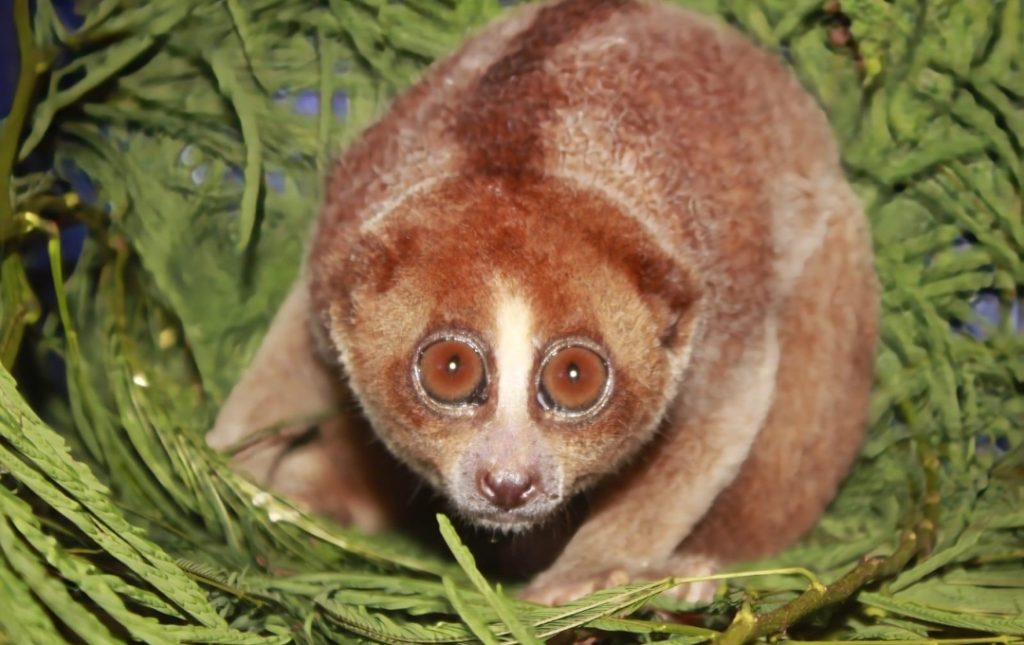
Once feared extinct, the Bangka slow loris has been rediscovered on an Indonesian island after decades without reliable scientific records. More than 90 individuals documented by wildlife rescuers are offering new hope for the endangered primate, but its survival remains threatened by tin mining, deforestation, and expanding oil palm plantations.
October 20, 2026 | Animals & Wildlife
For decades, scientists had little reliable information about one of Indonesia’s most elusive primates.
The Bangka slow loris (Nycticebus bancanus), a small nocturnal animal with reddish-brown fur and enormous eyes, had not been scientifically documented on Bangka Island since the early 1930s.
By 2020, the species was classified as Critically Endangered and possibly extinct by the International Union for Conservation of Nature (IUCN).
Now, new research has revealed that the mysterious primate has survived despite decades of habitat destruction and limited scientific attention.
An Indonesian wildlife rescue organization has documented more than 90 individuals across different locations on Bangka Island between 2015 and 2025.
The discovery offers an important conservation opportunity, but researchers warn that the species could still disappear without immediate habitat protection.
A Rare Primate Hidden in Indonesia’s Forests
The Bangka slow loris is a member of the slow loris group, a distinctive family of primates known for their slow movements and nocturnal lifestyle.
Unlike monkeys that move rapidly through trees, slow lorises travel cautiously along branches, searching for food under the cover of darkness.
Their large eyes help them navigate in low-light conditions.
The species is particularly unusual because it is one of the few venomous mammals in the world.
Slow lorises produce a secretion from specialized glands near their elbows. When threatened, they raise their arms and mix this secretion with saliva, creating venom that can be delivered through a bite.
The venom can cause severe allergic reactions in humans and may be life-threatening.
This makes the species especially vulnerable to inappropriate handling by people who encounter it in residential areas or plantations.
More Than 90 Animals Documented by Wildlife Rescuers
The rediscovery was made possible through years of work by Indonesia’s Alobi Wildlife Rescue Center.
According to research reported by Reuters, more than 90 Bangka slow lorises were documented between 2015 and 2025.
Many were rescued from houses, gardens, plantations, and roads.
Some animals suffered serious injuries, particularly from electrical wires.
Despite these dangers, the rescue program achieved an important conservation milestone.
After rehabilitation, 86 individuals were released into suitable natural habitats.
The findings demonstrate that the species survived in several parts of Bangka, rather than being restricted to a single isolated location.
However, the number of rescued animals should not be interpreted as a complete estimate of the wild population.
Scientists still need systematic field surveys to determine how many individuals remain and whether viable breeding populations exist.
Tin Mining and Palm Oil Expansion Threaten Its Survival
The discovery comes with a serious warning.
Bangka Island is internationally known for its tin resources, but mining activities have contributed to extensive environmental degradation.
Forest clearing, land conversion, and expanding industrial activities are reducing the natural habitats available to wildlife.
Oil palm plantations are adding further pressure.
For a small nocturnal primate that depends on forest environments, habitat fragmentation can create serious survival challenges.
Animals may become isolated, struggle to find food, and face greater exposure to roads, electrical infrastructure, and human settlements.
The disappearance of natural vegetation also threatens the ecological connections needed to maintain healthy wildlife populations.
Researchers have identified protecting the remaining forests as the most urgent priority.
Why This Discovery Matters Beyond Indonesia
The survival of the Bangka slow loris has implications beyond one island.
Scientists believe the discovery demonstrates why species considered potentially extinct should not automatically be abandoned as conservation priorities.
Remote habitats, limited research funding, and insufficient wildlife surveys can leave rare animals overlooked for decades.
Rediscoveries can provide opportunities to restore habitats and establish conservation programs before populations decline beyond recovery.
The case also highlights Indonesia’s importance as one of the world’s major biodiversity centers.
Its forests support numerous species found nowhere else on Earth.
Protecting these ecosystems is therefore essential not only for national environmental policy but also for global biodiversity conservation.
Conservation Must Go Beyond Rescuing Individual Animals
Wildlife rescue operations can save injured animals and return them to suitable habitats.
However, rehabilitation alone cannot guarantee long-term survival.
If forests continue to disappear, released animals may have nowhere safe to live.
Conservationists therefore face a broader challenge involving habitat protection, environmental law enforcement, scientific monitoring, and community participation.
Local communities must also be involved in protecting forests and preventing wildlife trafficking.
The long-term survival of the Bangka slow loris will depend on whether Indonesia can protect the remaining natural landscapes before they are permanently transformed.
A Second Chance for a Species the World Nearly Lost
The rediscovery of more than 90 Bangka slow lorises is an encouraging development for wildlife conservation.
But it should not be mistaken for proof that the species is safe.
The animals have survived decades of uncertainty, yet their future remains tied to the condition of the forests on Bangka Island.
Scientists now have an opportunity to understand the species better, map its remaining habitat, and develop stronger protection measures.
The next stage must focus on turning this discovery into lasting conservation action.
The Bangka slow loris has survived nearly a century of scientific uncertainty. Its greatest challenge now is surviving the destruction of the forest it calls home.