
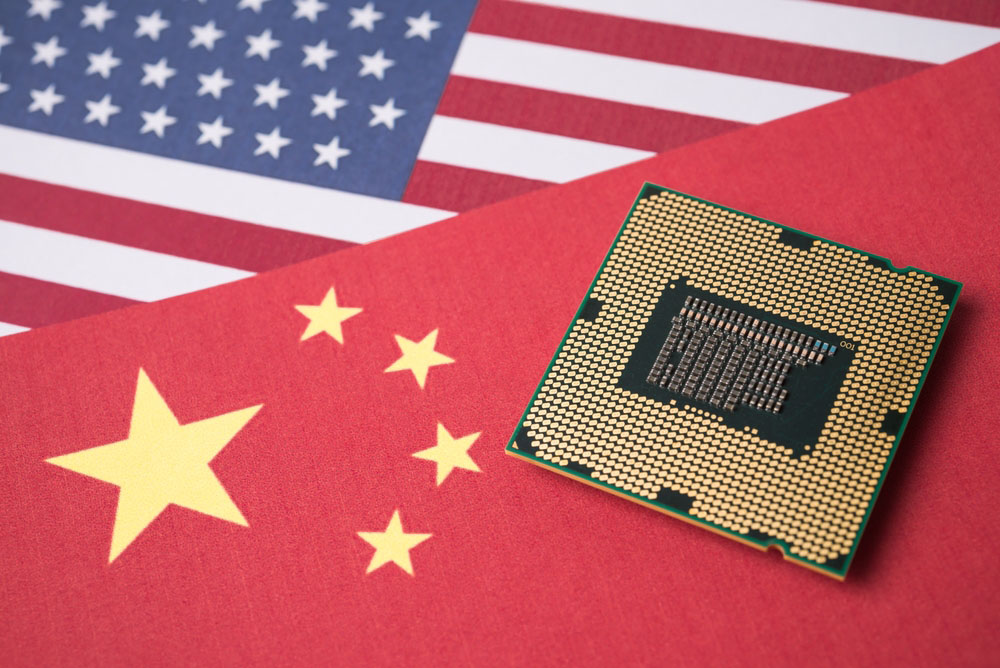
Washington is tightening its grip on the global artificial intelligence supply chain, targeting not only semiconductor exports to China but also the overseas data centers that provide access to advanced computing power. The move threatens to disrupt billions of dollars in technology investments and deepen the geopolitical battle over AI supremacy.
November 25, 2026
The global artificial intelligence race is entering a more aggressive phase as the United States expands restrictions on China’s access to advanced semiconductor technology.
The latest US measures are designed to close a critical loophole: Chinese technology companies accessing American-designed AI processors through data centers located in third countries.
The implications extend far beyond China. Data center operators, cloud providers, semiconductor manufacturers, and technology investors across Southeast Asia could find themselves caught in the middle of Washington’s increasingly aggressive technology controls.
The message from Washington is becoming increasingly clear: controlling access to advanced computing power is now a central part of its strategy to maintain technological leadership.
Washington Targets the Global AI Computing Network
Previously, US export restrictions largely focused on preventing advanced semiconductor shipments directly to Chinese companies.
However, technology companies could still obtain computing capacity through overseas data centers, effectively accessing powerful AI processors without importing them directly into China.
The new restrictions seek to close that route by requiring licenses for certain advanced computing arrangements involving companies based in China and other restricted jurisdictions.
This represents a significant expansion of US technology policy.
Instead of simply controlling where chips are shipped, Washington is increasingly scrutinizing who can access the computing infrastructure powered by those chips.
According to Maybank Investment Bank Research, the new restrictions could particularly disadvantage Chinese AI developers that depend on rented computing capacity rather than owning their own chips and data center infrastructure.
Companies such as Moonshot AI and MiniMax could face greater pressure as access to overseas computing resources becomes more difficult.
Alibaba and Tencent Face a New Infrastructure Challenge
China’s largest technology companies are not immune to the consequences.
Alibaba has warned that the restrictions could affect some of its global data center expansion plans, although the company is still assessing the full impact.
Its AI cloud and computing services generated nearly 61 billion yuan ($9 billion) in revenue during the July-September quarter, representing 53% year-over-year growth.
Meanwhile, capital expenditure increased 60% to 50.5 billion yuan ($7.6 billion), reflecting the enormous investment required to build AI infrastructure.
Tencent has also warned that the new restrictions could delay development of its next-generation AI models.
The problem is straightforward: advanced AI development requires enormous computing resources, and replacing access to Nvidia’s most powerful processors is not an easy task.
Southeast Asia Is Becoming Collateral Damage
Perhaps the most significant consequence of Washington’s policy is its impact on Southeast Asia.
Malaysia, Singapore, Thailand, and Indonesia are increasingly important destinations for data center investments. Their strategic locations, expanding digital economies, and growing cloud infrastructure have made the region attractive to global technology companies.
But the new US licensing requirements introduce another layer of uncertainty.
Data center operators in these countries will need to navigate tighter controls when purchasing advanced AI chips from Nvidia and other American manufacturers.
Malaysia has already begun discussions with Washington to clarify the implications of the restrictions.
The country’s government has also pledged to strengthen controls to prevent advanced Nvidia processors from being diverted to unauthorized users.
According to CIMB Bank, Malaysia could face a reduction of 0.19 percentage point in GDP growth in 2027 under a worst-case scenario involving prolonged disruption to data center operations.
Indonesia should pay close attention.
The country is competing to attract international cloud providers and digital infrastructure investment. If regulatory uncertainty increases across the region, investors may become more cautious about where and how they deploy expensive AI computing infrastructure.
China Will Accelerate Its Push for Domestic AI Chips
Washington’s restrictions could also produce an unintended consequence: accelerating China’s determination to reduce its dependence on American semiconductor technology.
Alibaba, Baidu, Huawei, and other domestic technology developers are investing heavily in alternative processors and computing platforms.
However, the technological gap remains substantial.
Maybank’s analysis, citing EpochAI estimates, suggests Huawei’s projected 2026 chip output is equivalent to approximately 880,000 Nvidia H100 units, compared with Nvidia’s projected 23 million units.
The disparity highlights the enormous challenge facing China’s semiconductor industry.
The problem is not simply designing a competitive processor. It also involves advanced manufacturing, high-bandwidth memory, software ecosystems, and the ability to produce chips at industrial scale.
China may eventually develop a more independent AI semiconductor ecosystem, but achieving that objective will require significant investment and time.
The Real Battle Is No Longer Just About Semiconductors
The latest restrictions reveal how artificial intelligence has transformed technology competition into a geopolitical contest.
Chips are no longer merely commercial products. They are strategic infrastructure, influencing national security, industrial competitiveness, economic growth, and technological independence.
For the United States, restricting access to advanced computing technology is a way to preserve its strategic advantage.
For China, the restrictions reinforce the urgency of building an independent semiconductor supply chain.
For Southeast Asia, the challenge is more complicated: attracting investment without becoming an extension of the technology conflict between the world’s two largest economies.
The global AI industry is now facing a difficult question.
Can the world build a truly interconnected digital economy when access to its most important computing infrastructure is increasingly determined by geopolitical alliances and export restrictions?
The answer could determine the next decade of global technology development.
The AI race is no longer just about who builds the smartest models. It is about who controls the chips, the data centers, and ultimately the computing power that makes artificial intelligence possible.