
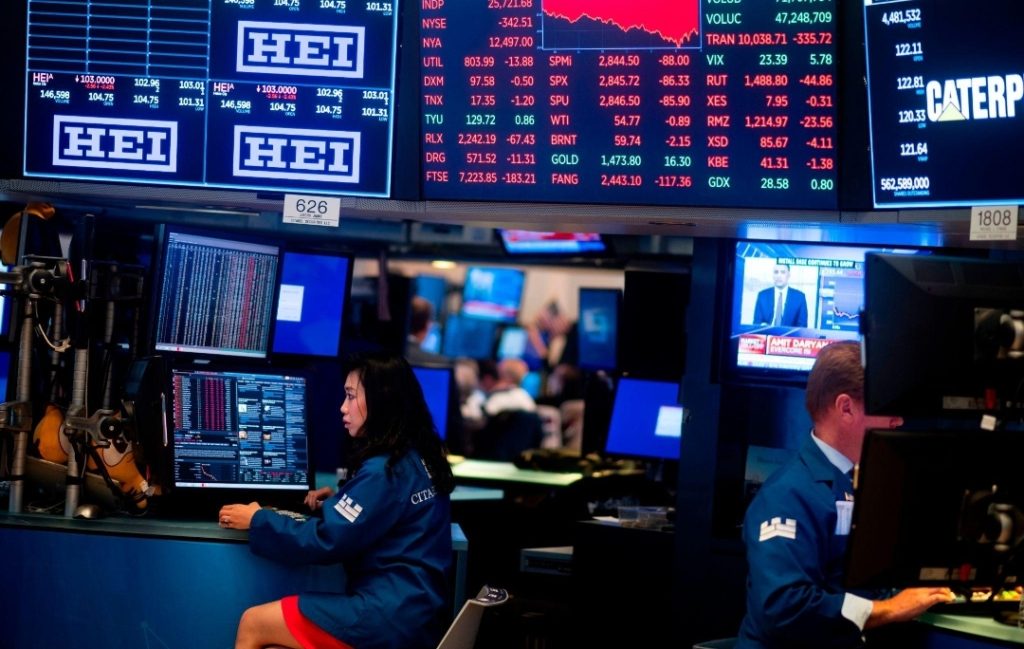
Global financial markets are facing renewed turbulence as the Trump administration prepares another wave of import tariffs targeting major trading partners. At the same time, technology stocks are losing momentum, raising concerns that the enormous investment boom surrounding artificial intelligence may be entering a more uncertain phase.
November 25, 2026 | Global Economy & Financial Markets
The global financial market is confronting two major sources of uncertainty simultaneously: escalating trade protectionism and growing questions about the sustainability of the artificial intelligence investment boom.
On Wednesday, November 25, international stock markets weakened after reports that Washington was preparing new tariffs against 16 major trading partners, including China, Japan, India, and members of the European Union.
The announcement came as investors were already reassessing technology valuations following renewed selling pressure in major AI-related stocks.
According to Reuters, MSCI’s global equity gauge declined 0.5%, while Asian markets outside Japan dropped 3.1%.
The developments demonstrate how quickly geopolitical decisions and technology-sector sentiment can influence international financial markets.
Trump’s New Tariff Strategy Raises Global Trade Concerns
The Trump administration is preparing additional import duties following an investigation into alleged excess industrial capacity among major trading partners.
The proposed measures target 16 economies and could affect a broad range of imported products.
Washington argues that industrial overcapacity and government support for manufacturing in foreign economies create unfair competitive conditions for American producers.
However, the potential consequences extend well beyond US manufacturing.
International companies depend on cross-border supply chains involving multiple countries. Higher tariffs could increase production costs, disrupt established supplier relationships, and force businesses to reconsider their manufacturing strategies.
For multinational corporations, the uncertainty surrounding future trade rules can be almost as damaging as the tariffs themselves.
Companies may delay investment decisions, postpone expansion projects, or relocate production to avoid additional trade costs.
The result could be a more expensive and fragmented global trading system.
AI Stocks Lose Momentum as Investors Reconsider Valuations
The second source of market pressure comes from the technology sector.
After a period of strong enthusiasm surrounding artificial intelligence, major technology stocks have experienced renewed volatility.
On Tuesday, Nvidia shares declined approximately 5.9%, while AI company Anthropic fell around 6.5%, according to Reuters market reporting.
The weakness raised questions about whether the enormous expectations surrounding AI-related businesses are already reflected in market valuations.
Investors are increasingly examining whether technology companies can generate sufficient revenue and profits to justify their massive infrastructure investments.
The concern is particularly important because the AI industry requires enormous spending on advanced processors, data centers, electricity infrastructure, and cloud computing capacity.
If revenue growth fails to match investment expectations, companies could face pressure to reduce spending.
Such a development would affect not only technology stocks but also semiconductor manufacturers, equipment suppliers, construction companies, and energy providers.
European Central Bank Warns About AI Financial Risks
The European Central Bank has also raised concerns about the financial risks associated with the AI investment boom.
In its November 2026 Financial Stability Review, the ECB warned that ambitious earnings expectations for AI companies could leave financial markets vulnerable to sudden corrections.
Another concern is the growing use of debt to finance AI infrastructure.
If investor sentiment changes significantly, losses could spread beyond equity markets into bond markets and other parts of the financial system.
The central bank also highlighted the interaction between AI-related financial exposure, government debt vulnerabilities, and geopolitical uncertainty.
The warning suggests that AI is no longer simply a technology-sector story.
It is becoming an increasingly important issue for global financial stability.
Federal Reserve Policy Adds Another Layer of Uncertainty
Investors are also watching US inflation data closely.
The October Personal Consumption Expenditures (PCE) report is particularly important because it provides the Federal Reserve with an important measure of inflation.
Higher-than-expected inflation could strengthen expectations that the central bank will maintain restrictive monetary conditions or consider another interest-rate increase.
Higher interest rates generally increase borrowing costs and can reduce the attractiveness of high-growth stocks whose valuations depend heavily on future earnings.
For technology companies financing expensive AI infrastructure, the combination of elevated borrowing costs and uncertain revenue growth could create additional pressure.
The situation also affects emerging markets, where stronger US interest rates can encourage capital flows toward dollar-denominated assets.
Emerging Economies Could Face a Difficult Trade Environment
Developing economies are particularly exposed to the consequences of renewed US trade restrictions.
Countries such as India, Vietnam, Indonesia, and Thailand are increasingly integrated into global manufacturing and supply chains.
New tariffs could affect export competitiveness and complicate efforts to attract international investment.
Indonesia, in particular, has been seeking to strengthen its manufacturing base, expand downstream mineral processing, and attract investment in electric vehicles and digital infrastructure.
A more protectionist international trade environment could make these objectives harder to achieve.
However, supply-chain diversification could also create opportunities for countries capable of offering competitive production costs, reliable infrastructure, and predictable regulations.
The outcome will depend on how governments and businesses respond to changing trade conditions.
The Global Economy Is Entering a More Complicated Financial Era
The latest market developments reveal a deeper transformation in the global economic system.
For years, investors benefited from relatively integrated supply chains, expanding international trade, and strong technology-sector growth.
Today, those assumptions face increasing challenges.
Trade restrictions are changing investment decisions, geopolitical tensions are affecting energy markets, and the AI boom is creating new financial exposures.
The European Central Bank’s warnings suggest that the consequences of a sudden correction in AI valuations could extend beyond technology companies.
Meanwhile, renewed tariffs could make international commerce more expensive and less predictable.
The Real Test for the Global Economy
The coming months will test whether global businesses can continue expanding investment while navigating higher trade barriers, uncertain monetary policy, and changing investor expectations.
Artificial intelligence may still deliver enormous productivity improvements, but technological potential does not guarantee attractive financial returns.
Likewise, protecting domestic industries through tariffs does not automatically produce stronger long-term economic competitiveness.
Governments and investors will need to distinguish between sustainable economic growth and expectations driven by temporary market enthusiasm.
The global economy is facing a difficult reality: the next financial shock may not come from a single crisis, but from the collision of trade protectionism, expensive capital, and increasingly uncertain technology valuations.